

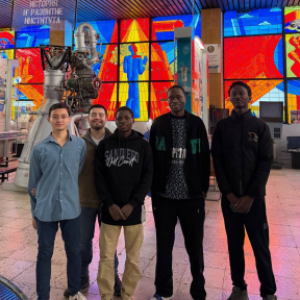
Students from the Center for Russian Language Education (CRLE) at Samara University—representing Peru, Venezuela, Mali, Cameroon, Costa Rica, Mexico, China, Vietnam, Nigeria, and other countries—took part in an educational visit to the university’s Museum of Aviation and Cosmonautics. The excursion formed part of their academic program and offered a compelling introduction to Samara’s rich scientific and engineering heritage as one of Russia’s key centers of aerospace industry.
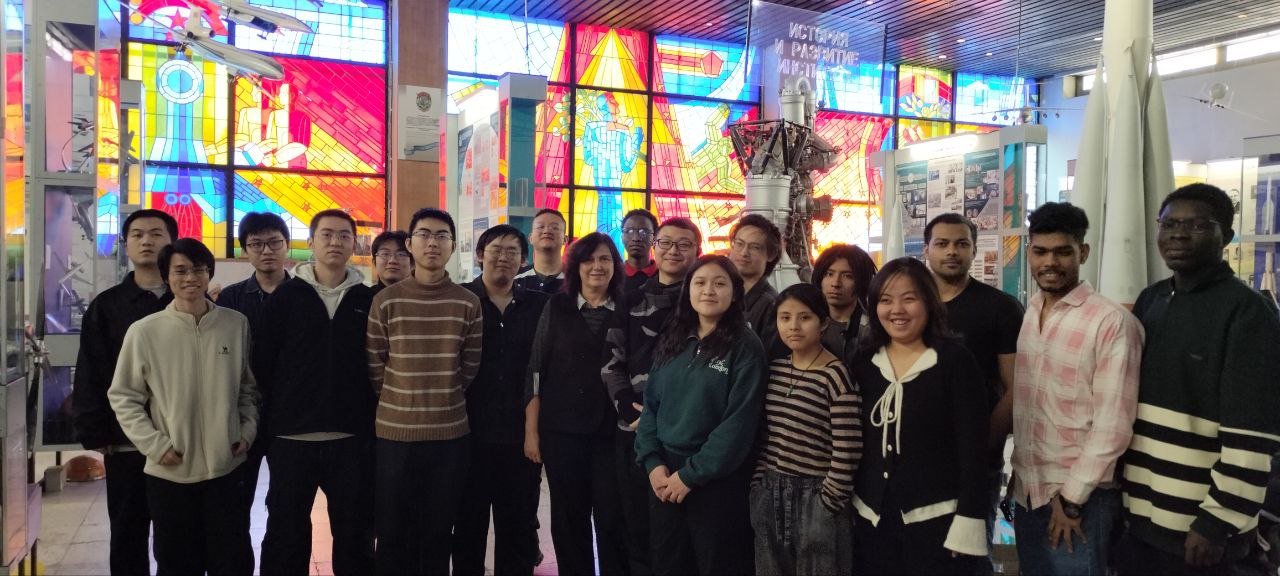
Inside the museum halls, the international guests learned about early aviation projects, the legendary Ilya Muromets aircraft designed by Igor Sikorsky, and the groundbreaking achievements of Soviet engineers and pilots. Special emphasis was placed on the Great Patriotic War era, when Kuibyshev (modern-day Samara) became the production hub for the iconic Il-2 ground-attack aircraft—the most mass-produced military plane of its time.
Equally captivated, students listened to stories about the dawn of space exploration. They discovered Samara’s pivotal role in the Soviet and Russian space programs, the legacy of Chief Designer Sergei Korolev, and Yuri Gagarin’s historic first human spaceflight.
Participants shared their impressions enthusiastically:
“I really enjoyed the excursion. I’d heard of Yuri Gagarin before, but I didn’t realize how deeply Samara is connected to the space industry,” said Luis Fernando Castillo Ortiz, a student from Costa Rica.
“It was fascinating to see real rocket engines up close and understand how they work. The guide explained everything very clearly,” added Anelis Sofía Romero Murgey from Venezuela.
“I loved seeing the spacesuits and space food—I’d only ever seen those in movies,” remarked Álvaro Jesús Olmos Muñoz from Mexico.
Several students were particularly moved by tales of courageous aviators and visionary engineers. “The story of the transpolar flight and the evolution of aircraft left a strong impression on me. I now understand how much courage and hard work such achievements require,” noted Étienne Koumata Scoti, a student from Cameroon.
Vietnamese students Nguyen Quang Nhat and Le Kieu Toan were especially intrigued by the daily life of cosmonauts aboard spacecraft.
According to participants, the museum visit was not only informative but also deeply inspiring. Such experiences help them better understand the history of the country where they study and appreciate the scale of scientific and technological progress.
“In the past, many physicists worked in laboratories. Today, thanks to their efforts, we can see actual aircraft components in this museum—and even travel to the sky and into space. I want to master these technologies, study them through the lens of science, and one day contribute to humanity just as those scientists did,” said Sun Chenyang, a student from China.
The excursion offered more than a historical overview—it provided a tangible connection to the legacy of great discoveries and the unique intellectual atmosphere of Samara University, one of Russia’s leading institutions in aerospace education and research.
Author: Alexandra Ruda, Additional Education Instructor, Center for Russian Language Education
